Category: Blog
-
Places to visit in Iceland: Major Attractions
Places to visit in Iceland: Major Attractions
Full of stunningly beautiful landscapes – dramatic, elemental and, in places, surreal, Iceland is a fascinating country. From majestic glaciers , volcanoes, cascading waterfalls, geysers and hot springs, rolling tundra, vast black sand beaches, tectonic plate boundary areas, to glacier lagoons with pure iridescent ice, beauty and fascinating natural phenomena in Iceland abound. In addition, Iceland’s unique cultural treasures add a whole new dimension to the experience of the “Land of Fire and Ice”.
The Golden Circle
The Golden Circle refers to the three most visited attractions in Iceland: Þingvellir (Thingvellir), Geysir hot springs and geyser area and the “Golden Waterfall” – Gullfoss.
Þingvellir (Thingvellir) “Parliament Plains”, is “the cradle of Iceland’s history”, as well as and one of the world’s most impressive natural wonders. It is the place where the ancient Alþingi (Althing), was founded in 930 AD, the oldest extant parliament in the world. For its cultural significance to mankind, Thingvellir was inscribed on the UNESCO World Heritage List. Located on the divergent tectonic plate boundaries of the Mid-Atlantic Ridge in soutwestern Iceland, Thingvellir is also renowned for its exceptional natural beauty and geological uniqueness.
Geysir is the geyser from which the word geyser originates. Together with geyser Strokkur, the hot springs and other geothermal features, it’s one of the most frequently visited attractions in Iceland.
Gullfoss, the Golden Waterfall, is Iceland’s most famous waterfall on the glacial river Hvíta. Tumbling down over a 32 m deep cleft, the waterfall is two-tiered, 2.5 km long and breathtakingly beautiful.
The Blue Lagoon
A geothermal spa set in quintessentially Icelandic lava landscape is a unique experience. Sited between Keflavík International Airport and Reykjavík, the Blue Lagoon is easily accessible from both locations.
Landmannalaugar
Landmannalaugar are part of Iceland’s central Highlands, the scenery of this area is diverse and fascinating: new lava, rhyolite mountains, natural geothermal pools, lush green valleys. These, and the views of the Hekla volcano and Torfajökull (Torfajokull) glacier area are just part of the reason for this area being such a popular sightseeing destination.
Þórsmörk (Thorsmork)
Thorsmork is a wide valley named after the Viking god þór (Thor). One of Iceland’s most popular hiking grounds, it’s surrounded by 3 glaciers: Myrdalsjokull, Eyjafjallajokull and Tindfjallajokull in the southern part of Iceland. This area offers picturesque vistas and impressive scenery, including the lovely Seljalandsfoss waterfall. Thorsmork is located about 160 km east of Reykjavik, in the Highlands of Iceland.
Lake Mývatn and Dettifoss
Lake Myvatn and its surroundings are famous for natural beauty, rare landscapes and vibrant birdlife. The lake is the 4th largest in Iceland, covering 36.5 sq. km, with more than 40 small islands. Lake Myvatn is about 90 km east from Akureyri. The many interesting sights include Jökulsárgljúfur (Jokulsargljufur), Ásbyrgi (Asbyrgi), Dimmuborgir cliffs and Dettifoss, Europe´s most powerful waterfall. Hljóðaklettar (Hljodaklettar) and Asbyrgi, are huge cliff formations formed by glacial floods from the Vatnajokull glacier. The Mt. Askja caldera is further to the south.
South Iceland
Hosting majestic glaciers, active volcanoes, impressive waterfalls, black sand expanses, and ancient Viking history, South Iceland area has some of the most spectacular of Iceland’s attractions. Eyjafjallajökull (Eyjafjallajokull) volcano and glacier, and Mýrdalsjökull (Myrdalsjokull) glacier are in this part. A more detailed description of these features can be found in our article on South Iceland.
Jökulsárlón Glacier Lagoon
Jokulsarlon is one of Icelands most spectacular sights, located about 60 km east of Skaftafell and some 400 km from Reykjavik. Jokulsarlon glacier lagoon is on the border of SE Iceland, at the foot of Vatnajökull glacier. Numerous birds live by the glacier lagoon and the nearby Breiðamerkursandur (Breidamerkursandur)is the main home to the great Skua. Eider ducks are also common. From May to September it is possible to take boat trip on the lagoon. Due to its exceptional beauty, Jokulsarlon has been used as a location for several Hollywood films.
Iceland’s National Parks
Þingvellir (Thingvellir) National Park, Snæfellsjökull (Snaefellsjokull) National Park and Vatnajökull (Vatnajokull) National Park, which includes Jökulsárgljúfur (Jokulsargljufur) in the north and Skaftafell in the south, are Iceland’s three national parks. Each is an absolute must-see for nature lovers, with their own unique features which are described in more detail in our articles on Iceland’s National Parks.
Vestmannaeyjar (Westman Islands)
Westman Islands archipelago and the island of Grímsey (Grimsey), in the Arctic Ocean also offer many attractions. Westman Islands are well known for their volcanic history and being the largest puffin colony in the North Atlantic. Grimsey is a small fisherman’s island, about 60 km from Akureyri, with about 100 inhabitants and millions of seabirds. This is Iceland’s northernmost point, right on the Arctic Circle.
East Iceland
This region has most of what makes Iceland so unique, as well as the reindeer in the wild, not found anywhere else in Iceland. Beautiful fjords, picture-perfect fishing towns and villages, steep mountains, highland farms, pure mountain streams, forests and woodlands, and vast expanses are typical of East Iceland. In some ways, the eastern part of Iceland still remains Iceland’s undiscovered treasure.
The capital Reykjavík
Reykjavik is a beautiful, striking city with avant-garde architecture, numerous interesting spots to visit and vibrant cultural life. Reykjavik is also perfectly located for taking day trips or longer journeys into the countryside.
-
Icelandic Sagas
Icelandic Sagas
“The Sagas of Icelanders have been the foundation of Icelandic culture, forged the nation’s identity and inspired people to bold deeds in times of adversity.”
*from the foreword to Páll Bergþórsson’s The Wineland Millenium, by the President of Iceland, Ólafur Ragnar Grímsson
The oldest surviving Icelandic literature is poetry, some of it almost certainly composed before the settlement of Iceland, either in Scandinavia or Scandinavian settlements elsewhere. However, these poems are only preserved in Icelandic manuscripts, and nowhere else.
The poems can be divided into two categories, the Eddic and the Skaldic poems. The Eddic poems are composed in free variable metres. There are two distinct classes of Eddic poetry: the heroic lays and the mythological lays. The form of the Skaldic poetry is much stricter than that of the Eddic poetry. The syntax is very complex, and the skalds used highly specialized vocabulary.
The greatest of all the skalds was Egill Skallagrímsson. One of his best known poems is Höfuðlausn (Head Ransom), composed in York c. 948. Egill was being held captive by Erik Bloodaxe, then ruling York, and was to be executed. During the night before the intended execution, Egill composed this poem in honour of his enemy, and was granted his own head as a reward.
Völuspá and Hávamál
The heroic lays are based on legends, many of which derive from continental Germany, and even from the Goths of south-eastern Europe. The mythological lays are about northern gods, and of wisdom attributed to them. The most famous of the latter are the Völuspá (Sibyl’s Prohecy) and the Hávamál (Words of the High One). Völuspá is spoken by a sibyl who tells the history of the world, of gods, men and monsters, from the beginning until the Ragnarök (Doom of the gods), when the gods will fall, the sun become black, smoke and fire will gush forth and the earth sink in total darkness.The Hávamál is a didactic poem in which the god Óðinn (Odin) gives instructions about social conduct and speaks of runes and magical powers. The Hávamál was almost certainly composed before the settlement of Iceland, and handed down orally until it was written down in Iceland.
Iceland’s medieval chronicles
During the 12th and the 13th centuries there were some great historians at work in Iceland, concentrating on Icelandic history and the histories of the kings of Norway. The most important works of this genre are Íslendingabók – The Book of Icelanders, composed around 1125 by Ari Þorgilsson the Learned (Ari the Wise), Landnámabók – The Book of Settlements, a detailed history of the settlement of Iceland, and Heimskringla – Orb of the World, a history of the early kings of Norway. Heimskringla was written by Snorri Sturluson (1179-1241). Snorri also wrote the Prose Edda, a handbook of prosody and poetic diction. In it are many tales of pagan gods and heroes.The major categories of sagas include: histories, saints’ lives, Icelandic family sagas, kings’ sagas, contemporary sagas, chivalric romances and legendary sagas.
The Sagas of Icelanders
Islendingasögur – The Sagas of Icelanders (the “Family Sagas”) written in the 13th century, are the crown of Icelandic literature, and can be considered the first prose novels of Europe. Remarkably, the sagas were written in the vernacular Old Norse. These sagas are family chronicles, describing the events that took place during the period of the Icelandic Commonwealth in the 10th and 11th centuries AD. They were written by anonymous authors.Around 40 family sagas are preserved in the manuscripts from the 13th, 14th and 15th centuries. The artistic values of the best of the sagas are indisputable and they are amongst the most important European literary works of the past millennium. Most of the sagas bring together historical and fictional elements in a unified narrative. Their characterization is vivid and they show deep sympathy and understanding of human tragedy. The style is plain, unpretentious and concise, with adjectives used sparingly, and with great emphasis on dialogue.
The sagas are about love and hatred, family feuds and vengeance, loyalty and friendship, conflicts due to matters of honour, warriors and kings, and destiny. Some of the best known sagas are Grettir’s Saga, about the outlaw Grettir the Strong; Laxdaela Saga, a delicately woven tragedy, covering four or five generations, with women playing prominent roles; Egil’s Saga, about the defiant Viking warrior poet Egill Skallagrímsson; and Njal’s Saga, generally considered the greatest of them all, about two heroes, Gunnar, a noble warrior without equal, and Njáll, a wise and prudent man with prophetic gifts; their friendship and heroic deaths.
The greatest collector of Old Norse manuscripts was the Icelander Árni Magnússon (1663-1730).
In 2009, Árni Magnússon’s manuscripts collection, the Arnamagnaean manuscript collection, was inscribed on the UNESCO Memory of the World Register, world cultural heritage list, with a special mention of the major significance of the Sagas of Icelanders for the wider world.
The sagas remain an intrinsic part of Icelanders’ identity today, and lie at the heart of Iceland’s modern culture. They have also had an enormous impact on world literature, and were admired by writers from around the world, including William Blake, William Morris, JRR Tolkien and Jorge Louis Borges, to name just a few. -
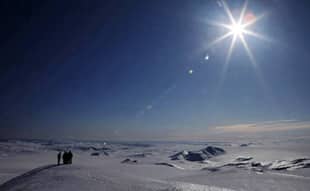
Iceland’s Vatnajökull glacier is Europe’s largest icecap
Iceland’s Vatnajökull glacier is Europe’s largest icecap
Vatnajökull (2110 m) is the largest glacier in Iceland and it’s also the largest glacier mass in Europe. It covers an area of roughly between 8100 sq. km and 8300 sq. km, and it’s about 1000 m thick at its thickest point. Its average thickness is 400 – 500 m, and the total ice volume of Vatnajokull is probably in the vicinity of 3300 cubic km.
In 2008, Vatnajökull glacier and its magnificent surroundings were declared a national park. Two existing national parks, Skaftafell in the south and Jökulsárgljúfur in the north, as well as several nature reserves, were integrated into the newly established Vatnajökull National Park, thereby creating the largest national park in Europe. Vatnajökull National Park covers 13% of Iceland. The Park showcases a stunning variety of landscape features, shaped by nature’s mightiest forces.
vatnajokull-people-night-310×191.jpgVatnajokull glacier is named after subglacial lakes in a very volcanically active region in its centre. The ice cap covers an undulating highland plateau, generally reaching 600-800 m altitude. The subglacial landscape is dissected by numerous broad and narrow subglacial valleys and spectacular canyons. The Equilibrium-Line Altitude (ELA), level at which accumulation and ablation are in balance, lies at approximately 1100 m a.s.l. along its southern margins, at 1200 m along its western part, and at 1300 m in its northern part. About 60% of the glacier surface is above the ELA. A great number of glacier snouts of different sizes flow down onto the lower lying areas.
No glacier in Iceland has been researched more thoroughly than Vatnajökull. The research started in 1934 when the lake region erupted and, ever since the Iceland Glaciological Society was founded in 1950, it has continued every year. The Iceland Glaciological Society owns huts in several places on the icecap. The latest eruptions of the lake region took place in 1996, 1998, 2004 and 2011. The first confirmed trip across the icecap from the south and back was accomplished in 1875 by an Englishman and a few Icelanders. They were the first to see the Askja eruption the same year and report it to the people living on Lake Mývatn (Myvatn).
Vatnajokull’s concealed volcanoes
Seven volcanoes are located underneath the Vatnajokull icecap and most of them are active volcanoes. The western part of the great Vatnajokull icecap partly conceals the volcanic fissure systems of the Mid-Atlantic Ridge plate boundary. Two major volcanic centres lie beneath the ice: the Bárðarbunga (Bardarbunga) volcanic centre and the Grímsvötn (Grimsvotn) volcanic centre, both with large subglacial caldera depressions.The Bardarbunga (2000 m) centre is part of a fissure system extending over 100 km to the south and some 50 km to the north of the glacier. The last eruption within the Bardarbunga centre occurred in 1910, but eruptions on the fissure system have occurred in 871 AD, 1477 AD and 1862 AD, all producing substantial amounts of lava. Grímsvötn volcano (1725 m), together with Hekla, has been Iceland’s most active volcano since the Middle Ages. Grimsvotn last erupted in 1996, 1998, 2004 and yet again in 2011.
Kverkfjöll (Kverkfjoll), around 1920 m high, is a large glaciated central volcano on the northern edge of Vatnajokull. Due to a fault scarp, there is a powerful high temperature area consisting of hot springs, mud-holes, steam blowholes and a luke-warm lake. The hot springs area is around 3 km long and almost 1 km wide. Underneath the glacier, there is an ice cavern system several km long.
Öræfajökull (Oraefajokull), 2110 m high, is a broad glacier-clad stratovolcano at the SE end of the Vatnajökull icecap. A major silicic eruption which occurred in 1362 was Iceland’s largest historical explosive eruption. Another eruption occurred during 1727-28. Both eruptions were accompanied by major jökulhlaup (glacier outburst floods) that caused property damage and fatalities.
1996 subglacial eruption & jökulhlaup
Late in the evening of September 30, 1996, seismometers detected the beginning of an eruption under the Vatnajökull icecap. One of the volcanoes had previously collapsed and formed a caldera named Grímsvötn, in which a subglacial lake had accumulated. Late on October 1, the surface of the ice over the caldera had risen 10-15 metres. The next day, the eruption broke through the surface of the ice, emitting an ash cloud ten kilometres high. The volcano quieted on the thirteenth, but the ice continued to melt and overflow the Grímsvötn lake. More than three cubic kilometres of ice melted, but little was emitted through normal runoff points. Since an ice dam and the caldera itself held the melt back, the jökulhlaup would not occur until November, or at least one month later.At 7:20am on the fifth of November, the meltwater burst vertically from two kilometres above the tongue of the glacier. By four that afternoon, the jokulhlaup was fully realized. A mixture of sediment, meltwater, and ice moved at ten kilometres per hour from the full twenty-kilometre width of the glacier’s terminus across Skeiðarársandur (Skeidararsandur), forming standing waves three and four metres high. The total flow peaked at over fifty thousand cubic metres per second in the five outwash channels, making it briefly the second largest river of the world. The flood obliterated a 376-metre-long bridge, the majority of a second bridge, nine hundred metres in length, twelve kilometres of roadway and twenty-three power-line towers, causing fourteen million US dollars in damage, while adding seven square kilometres to the area of Iceland. Thankfully, there were no fatalities or injuries, and the flood did not reach any nearby settlements.
There is little doubt that these events occurring in the eastern part of Iceland in late 1996 had an impact felt around the world. The phenomenon of a subglacial volcanic eruption is not often encountered; therefore, numerous journalists and scientists from around the world met in Iceland during the eruption to study the events and ramifications of these occurrences. The study of volcanoes, especially active volcanoes located under glaciers, has since broadened its scope of research into the distinct volcanism of volcano-glacial ice interactions, or glaciovolcanism, in order to unlock more of the secrets of our planet. Undoubtedly, anything learned from the Vatnajokull incident and others like it can be applied to other fields, including plate tectonics and the behaviour of land on other planets.
Iceland´s highest peak, Hvannadalshnúkur /Hvannadalshnjúkur (Hvannadalshnjukur) is in Vatnajökull glacier and rises 2110 metres above Iceland´s south shore. One of the most amazing sights of Vatnajökull glacier is the Jökulsárlón (Jokulsarlon) glacial lagoon.